None of the information provided is investment or tax advice and we always recommend you speak to a financial adviser before investing.
Some of our products are high risk and you should read the associated risks before deciding whether to invest. These can be found on the relevant product web pages and in our guide to risks.
Please confirm you have read the information above.
Before accessing this website you must confirm you meet the below criteria and are happy to proceed based on the information provided. If you are not able to make this confirmation you must not proceed any further and should decline to accept these terms.
The information contained on this website is directed at and to be accessed by persons in the United Kingdom only, and not at any other country where the extension of availability of such information/materials would breach any applicable law or regulation.
The content of this website is directed at persons having professional experience of participating in unregulated schemes, and units/schemes that are promoted are available only to such persons. Persons who do not have professional experience in participating in unregulated schemes should not rely on it. It is for general information only and should not be regarded as constituting an offer or a solicitation to buy or sell any securities, or as investment or tax advice.
If you are in any doubt as to the suitability of the products for your circumstances, please seek specialist financial or tax advice. Participation in these schemes will put capital at risk and will be illiquid. More detailed information on the specific risks of the fund/strategy will be available in the offer document/prospectus/on request.By entering this website you agree to our Terms & Conditions found here. Please confirm you have read and agree to the information above.
UK tax-paying investors have a number of tax reliefs available to them if they invest in an EIS-qualifying company.
1. Income tax relief
Investors can claim up to 30% income tax relief on EIS investments, which gives an incentive for some of the risk normally associated with funding small companies. The maximum investment that investors can claim relief on in a single tax year is £1 million, which amounts to £300,000 of income tax relief.
Investors can get relief in the tax year money is invested into a company. This might be different to the year the investment is made into an EIS fund because of the time taken to make investments.
Investors in unapproved EIS funds can choose to treat an investment as if it was made in the previous tax year, which can be useful for tax planning. It also means that up to £2 million can be invested in a tax year (i.e. £1 million in the current tax year and £1 million carried back to the previous tax year).
Please note, investors have to hold shares have for at least three years and the company must remain EIS-qualifying for three years. If not, they’ll have to pay this tax relief back to HMRC. Income tax relief has to be set against the income tax bill for a tax year, but it can only reduce your income tax bill to nil.
2. Tax-free growth
When investors sell EIS shares, any growth in value from an investment is 100% tax-free. Which is worth noting because small, early-stage companies have the potential to grow significantly.
To qualify for this relief, income tax relief must have already been claimed – and not withdrawn by HMRC. Also, investors have to hold the shares for at least three years, and the company must remain EIS-qualifying for at least three years.
Knowledge Intensive Companies (KICs)
KICs offer added flexibility in terms of the maximum amount that can be invested. This increases to £2 million per tax year provided at least £1 million is invested in KICs.
If an investment is treated as if it’s made in the previous year, investors can invest a total of £4 million: £2 million for the current tax year and £2 million for the previous tax year.
3. Capital gains deferral
A gain made on the sale of other assets can be reinvested in EIS shares and deferred over the life of the investment. There’s no upper limit on the value of gains that can be deferred.
It’s important to note that it’s the gain, not the proceeds of the sale that should be reinvested. For example, if an asset was sold for £50,000 and cost £10,000, this would result in a gain of £40,000. This £40,000 would need to be reinvested in EIS-qualifying shares in order to defer the gain.
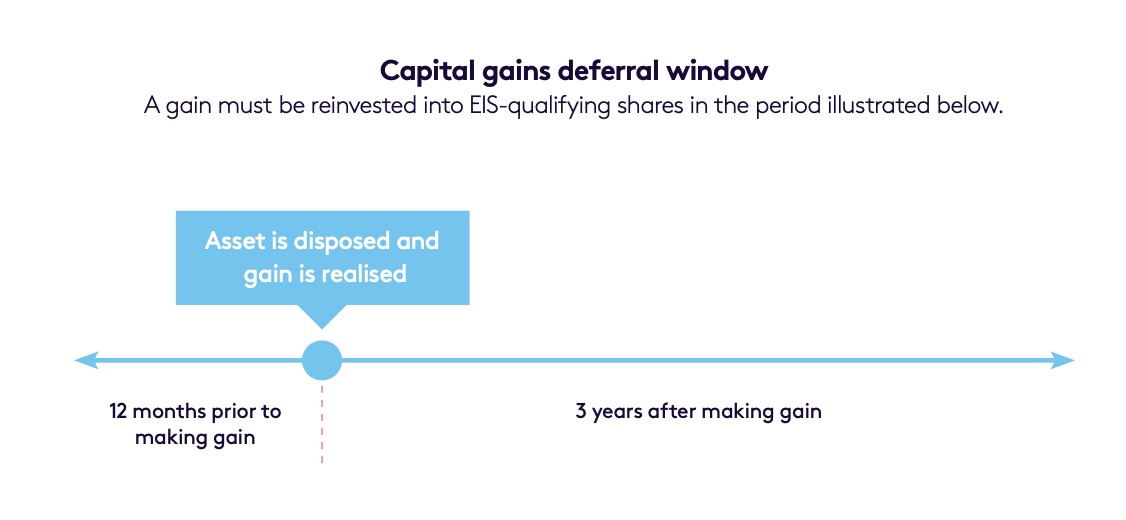
To qualify for deferral relief, the reinvestment into EIS-qualifying shares needs to be made no earlier than 12 months prior to, or three years after, the original gain was made.
The gain will be deferred until the earliest of any of the following events:
The EIS shares are sold.
The company ceases to be EIS-qualifying within three years of investment.
An investor ceases to be a UK resident within three years of investment.
When the deferred gain comes back into charge, it’s subject to capital gains tax at the relevant rate at that time.
A deferred gain that comes back into charge can be deferred again if it’s reinvested into a new EIS-qualifying investment. If the investor dies owning the EIS shares, the gain will be eliminated.
4. EIS and Inheritance tax relief
EIS shares qualify for Business Relief. This means they can be left to beneficiaries free from inheritance tax, as long as they’ve been held for at least two years at the time of death.
5. Loss relief
EIS-qualifying investments involve buying shares in early-stage companies, so the risk of these shares dropping in value is higher than most investments.
EIS loss relief reduces the impact of losses made on individual companies. This is the case even if an investor holds a portfolio of EIS companies that, overall, has delivered a positive return.
Please remember
The tax reliefs from an EIS-qualifying investment are a valuable compensation for some of the associated risks to an investor’s capital. However, tax reliefs depend on qualifying criteria and personal circumstances.